MEDDPICC for SMB SaaS: Does It Actually Fit Your Team?
MEDDPICC was built for enterprise deals. Here is where it breaks on an SMB SaaS motion, and the two-scorecard system that fits shorter cycles instead.
Carla Macciocu
Sellcrafter
The scene repeats in a lot of SaaS companies.
A new sales leader arrives, and within two weeks MEDDPICC is on the roadmap, because it worked beautifully at their last company, where deals took nine months and legal had its own floor.
Six months later the CRM has eight new mandatory fields, reps fill them in the night before pipeline review, and nobody can say whether qualification actually improved.
This article covers what MEDDPICC is, the deals it was genuinely built for, the specific ways it breaks on an SMB SaaS motion, and what a methodology that fits that motion looks like instead.
The point is a clear-headed decision, whichever way it goes.
What MEDDPICC actually is
MEDDPICC is a qualification framework built around eight criteria a rep documents for every deal: Metrics, Economic Buyer, Decision Criteria, Decision Process, Paper Process, Identify Pain, Champion, and Competition.
It grew out of the MEDDIC framework developed in the enterprise software world of the 1990s, with Paper Process and Competition added for deals where procurement and legal shape the timeline.
Understood on its own terms, it is a rigorous system for one specific situation: a large, long, multi-stakeholder deal where buyer commitment already exists and the job is to qualify it, navigate it, and de-risk it.
Procurement steps. Security reviews. A genuine economic buyer three levels above your contact. In that world, MEDDPICC earns its complexity.
Where it breaks on an SMB SaaS motion
The SMB SaaS motion is structurally different, and each difference hits one of MEDDPICC’s load-bearing assumptions.
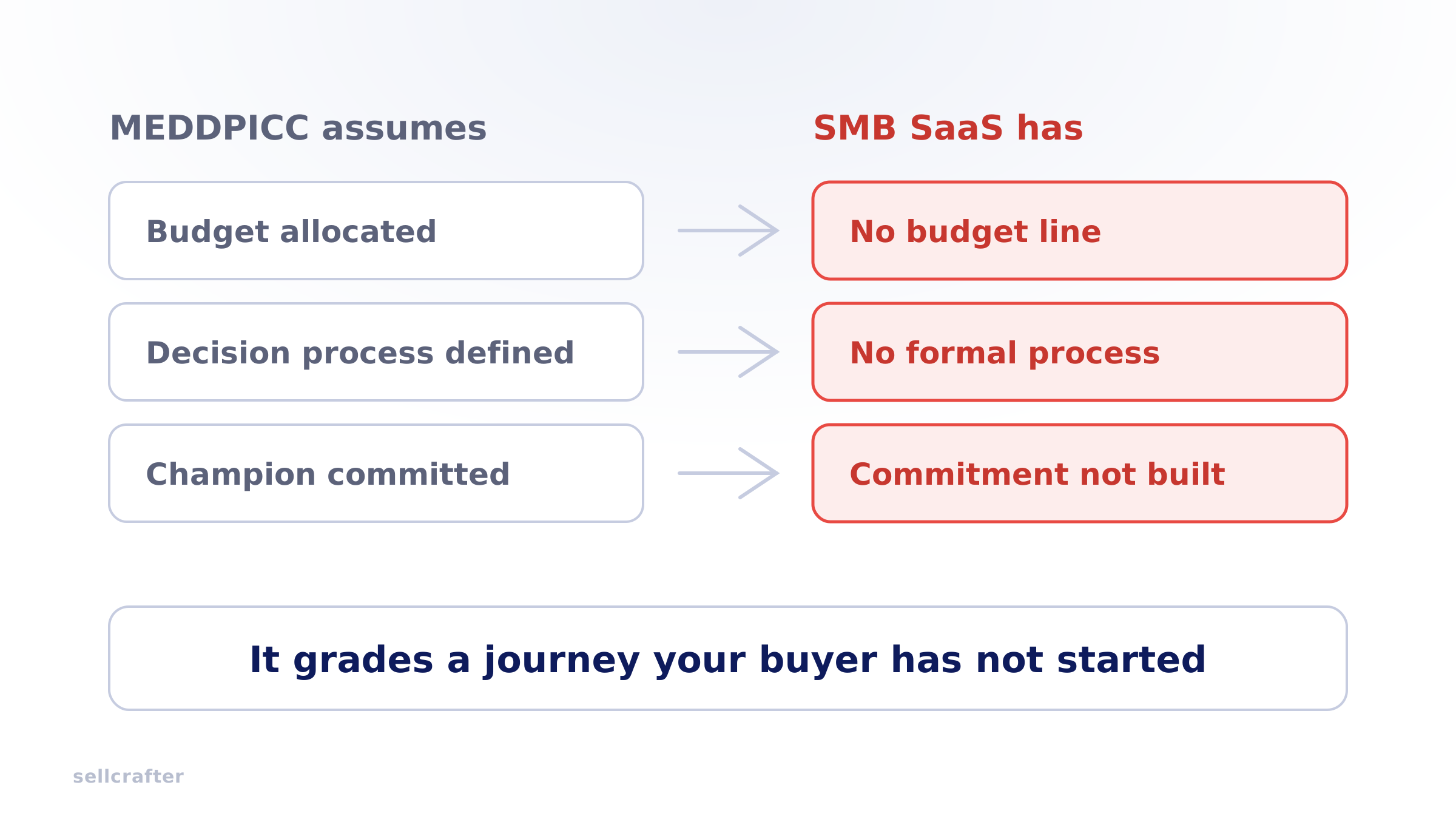
The commitment does not exist yet. MEDDPICC assumes a buying process is underway and your job is to qualify your position in it.
In SMB SaaS, your buyer often has no budget line for this, no formal decision process, and no procurement to navigate. The rep’s job is to create commitment, and MEDDPICC contains no machinery for that.
Eight criteria against a short cycle. When a deal closes in weeks, asking reps to document eight fields per deal produces one of two behaviors, both observable in your CRM: fields gamed with plausible filler, or fields ignored until the night before pipeline review.
Full adoption of a framework this size takes months, and during those months you are running two systems badly instead of one well.
One framework stretched across two different calls. What matters in discovery is different from what matters in a demo. A single monolithic checklist pushes reps to front-load everything into the first call or skip half of it entirely.
Either way, the framework stops describing what actually happened on the call.
The diagnosis is buried. A half-completed MEDDPICC record tells you a rep skipped some fields. It does not tell you, at a glance, whether this deal is stalling for lack of urgency or dying because a hidden stakeholder was never found.
You end up needing the long pipeline review the framework was supposed to replace.
None of this makes MEDDPICC a bad framework. It makes it the wrong tool for a motion with shorter cycles, fewer stakeholders, deals in the tens of thousands rather than the high six figures, and buyers whose commitment has to be built on the call.
The usual alternatives, briefly
BANT. Budget, Authority, Need, Timeline, created at IBM in the 1950s for perpetual license deals decided by one person.
Today several people touch even a small deal, and opening with budget questions before any pain is established plays as interrogation. The polite description is “a simple qualification checklist.” The accurate one is a script for making your reps sound like auditors.
SPIN. In my view the best questioning technique available, and worth teaching. It is a technique, though, and a complete methodology also needs multithreading, urgency, and next-step discipline. SPIN covers none of those.
Nothing. The most common choice by default. Every rep sells their own way, some well, some badly, and you cannot tell which is which because there is no standard to score against.
The cost is invisible until you try to diagnose why the forecast keeps slipping.
What fits the motion instead
The methodology I run with SMB SaaS teams is built on one structural choice: two short scorecards instead of one monolithic framework. One for discovery, one for demos, because those calls have different jobs.
Discovery is scored on five pillars, PIMEN. Pain, stated explicitly by the prospect, with consequences, because a situation is a fact and a problem has consequences. Impact, quantified, which replaces the budget conversation: a problem costing far more than your price answers the affordability question itself. Multithread, handled with two questions: who else wants this solved, and who might think this is the wrong way to solve it. Event, a concrete trigger or deadline, the most reliable predictor of whether a deal closes on time or slides into next quarter. Next step, a date, named attendees, and an agenda, booked before the call ends.
Demos are scored on four pillars, PAVE. Problem restated and confirmed before a single screen is shown. Alignment, meaning the demo covers what the prospect said hurts and nothing else. Validation, where the prospect says out loud that what they saw solves the problem, and that it matches how they imagined solving it. Engagement, the next meeting locked with the people who can block the deal in the room.
After every call, each pillar scores green, yellow or red, and the manager reads the pipeline in color.
A deal green on discovery and red on Validation needs demo coaching. A deal red on Event will stall regardless of how much pain exists.
And the pattern across reps answers the question every framework should answer: one rep red on Multithread is a coaching issue, every rep red on Multithread is a playbook issue. The wrong diagnosis leads to the wrong fix, so the methodology exists to make the right one obvious.
A rep learns the whole system in a day, and a manager grades any call in about two minutes. For the fuller decision logic, including when a heavier framework is justified, see the guide to choosing a sales methodology.
When a team does graduate to MEDDPICC
The trigger is the deal, not the org chart.
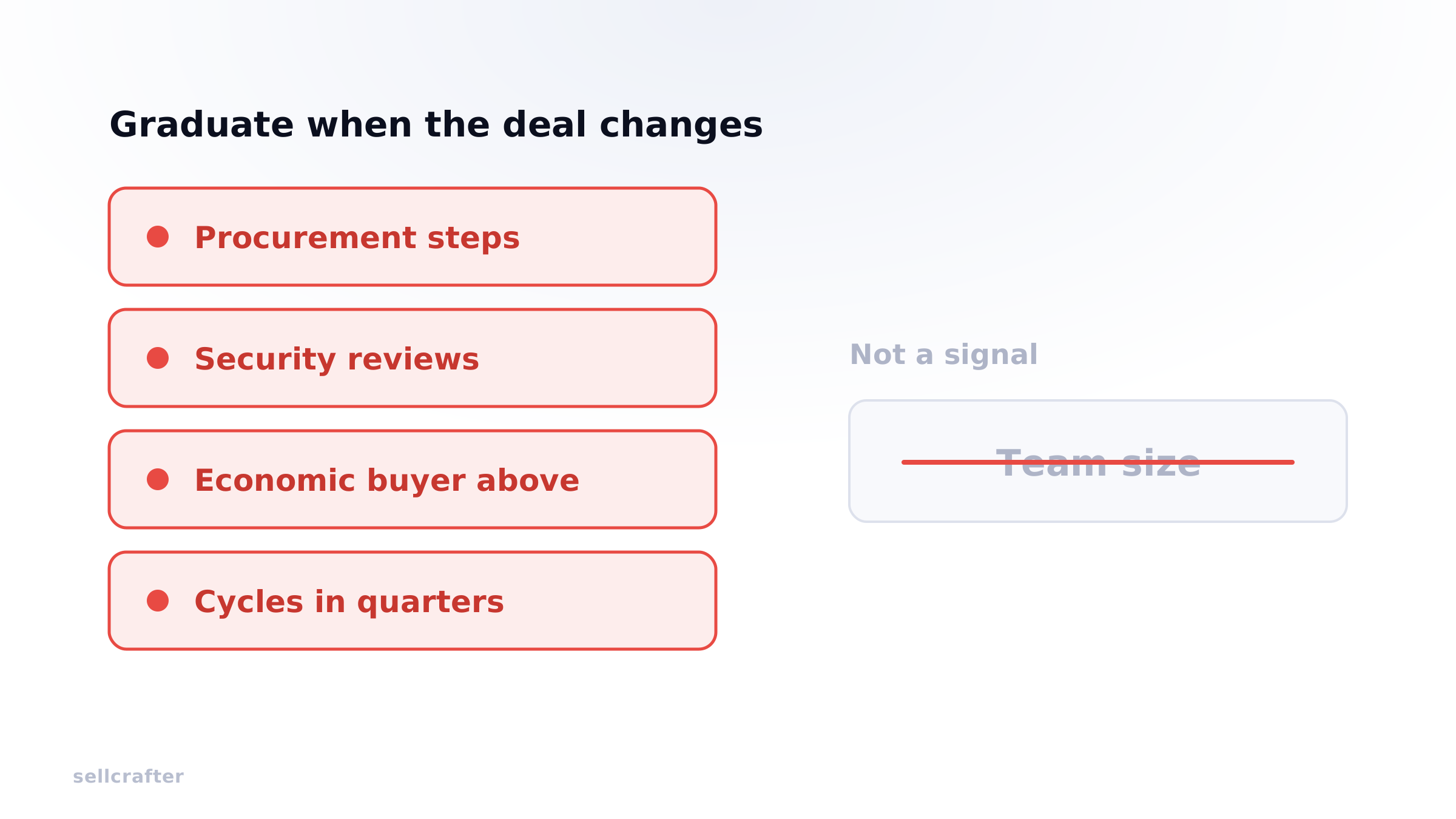
When real procurement steps appear, when security reviews enter the timeline, when there is a genuine economic buyer sitting above your contact, and when cycles stretch into quarters, the eight criteria start earning their keep.
At that point the overhead buys you something: a shared map of a buying process complex enough that nobody holds it in their head.
Before that point, you are paying enterprise overhead on a motion that has not become enterprise yet.
How to inspect whether your current methodology fits
Whatever you run today, the evidence is already in your systems.
- Open ten active deals and check when the qualification fields were last edited. Batch edits the night before pipeline review mean the framework is being fed, and the framework being fed means it is not being used
- Listen to three discovery calls and count how many framework criteria were genuinely addressed on the call versus reconstructed afterwards
- Check where stalled deals sit: a pile of deals with pain documented and no compelling event is a methodology that qualifies interest without building urgency
- Time your pipeline reviews: if diagnosing one deal takes half an hour of conversation, the framework is not carrying the diagnosis
FAQ
What is the difference between MEDDIC and MEDDPICC? MEDDIC is the original six criteria. MEDDPICC adds Paper Process and Competition, aimed at deals where procurement, legal and competitive bake-offs shape the outcome. If those two additions sound foreign to your deals, that is a useful signal about the whole framework.
Can we run a lighter version of MEDDPICC? Teams try, usually by dropping to four or five fields. At that point you are designing your own methodology anyway, so design one whose pillars match your motion and your calls, instead of a subset chosen by deleting the fields reps complained about.
When does a team graduate to MEDDPICC? When the deals change: real procurement steps, security reviews, a genuine economic buyer above your contact, cycles measured in quarters. Moving upmarket is the trigger. Team size is not.
Is BANT ever the right choice? As a mental checklist of things worth eventually knowing, it is harmless. As a call structure, it front-loads the two questions, budget and authority, that buyers trust least from a stranger.
How long does it take to switch methodologies? Switching costs less than most leaders expect, because the expensive part of a rollout is not the teaching, it is the CRM work and the months of half-adoption. A system a rep learns in a day and a manager grades in two minutes skips most of that.
The decision for a small, fast-moving team
MEDDPICC is a serious framework for a kind of deal most SMB SaaS teams are not running.
The choice in front of you is between a framework built to qualify commitment that already exists, and one built to create commitment and make every call inspectable in minutes.
Whichever you pick, pick it for your motion: your cycle length, your stakeholder count, and how much of the buying process your reps have to build themselves.
I’m Carla. I build sales enablement systems for B2B SaaS teams, coach the managers to run them, and hand them off.
The system only works written down, where reps can run it and managers can grade against it. To document yours, start with the sales enablement cookbook, or book a call and we will pick the fit together.
Written by
Carla Macciocu
Sales enablement consultant working with B2B SaaS teams from Seed to Series C. Runs Pimp My Playbook out of Sellcrafter.